Translate

Tuesday, 12 August 2014

Post 38 Les Pyrenees

Now that  l'm out of La Garrigue l notice how quiet it is without the Cigales making such a noise. [Cigales are a large insect and like grass hoppers rub their back legs together to make a noise and it's incredibly loud]. l can hear skylarks and buzzards again. It's really green here and the grass is lush. The horse is content. At Montreal l stop in a grove of walnut trees, a lady with her little grandson brings me a bottle of beer, they chat and look at the horse.  I head across country on peaceful roads, in the distance the mountains are rearing up 10,000 feet.
Out of La Garrigue near Carassonne
11th of July. A hind shoe comes off the horse going through a village . I stop and fix it back on, a kind man who keeps bees, telephones Le Maire for me and arranges for me to stop at Rochefort- Les- Cascades, a lovely spot by some waterfalls. The grass is good and there is a spring for drinking water. I'm quite tired after walking 12 miles and fixing shoes on tires me out, but as soon as l've stopped some Dutch people come over and chat to me, they are nice to talk to and buy two of my pieces of copperwork. Everytime people come and chat to me is an opportunity to sell something.
I'd just sat on the bed to rest, when l hear horses coming. It's a Frenchman with two horses, one he rides, the other carries his belongings. He is camped on the other side of the hill but has come to water his horses, [l'm not sure why he didn't camp by the water]. He comes and chats to me, he's been travelling for 3 weeks and knows all about it. He starts to tether one of his horses too close to mine and this is dangerous, so l get him to move it further away. The other horse he leaves loose, l warn him that when the loose mare goes to see my horse she may get tangled in the chain. He tells me that will not be a problem. A few moments later the mare goes over to my horse, my horse chases her off and she catches her legs on the chain, luckily neither my  horse or his mare is injured. Anyway we chat about travelling with horses. I notice that the mare he is riding has a saddle sore. I ask him if he's read Aime Tschiffleys book Southern Cross to  Pole star. [In the 1920s Tschiffley rode two horses from Buenos Aires to Washington, about 10,000 miles]. The Frenchman says he hasn't but says he knows the book, he's also adamant, despite not reading the book, that Tschiffley rode south and not north. I find this a bit frustrating, so l suggest that we have a bet and whoever is wrong gives the other his horse! Suddenly the Frenchman is not so sure of his ground and not quite brave enough to shake hands on it. Shame l would have liked his mare.
While we are talking a small group of young foreign exchange students comes to look at the horse and wagon. They come from Russia, Albania and Serbia, they are nice to talk to, they are a bit fed up, they were dropped off by a minibus some hours before and there is nothing here except a waterfall. I'm glad of their company, they're still enthusiastic about their life ahead, whereas the Frenchman [who is 38], for the moment, is burdened by his disappointments and failures.
The Frenchman is a bit disparaging about travelling with a wagon because l have to use roads, whereas he can use bridleways, though he does concede that it looks a more comfortable way to travel. He asks me how long it takes  to get ready in the morning, he is surpised when l say 5 minutes. He tells me it takes him one and a half hours! Some years ago l talked to a man who'd been a mule driver in the British army in Burma during the second war. He told me that as part of their training they had to be able to load the mules up in pitch darkness within a few minutes. [I didn't mention this to the Frenchman]. The mules arrived by ship from South America to India. They were unbroken. The  mules were trained intensively for 6 weeks, by which time they were expected, literally, to be bombproof and ready to use. The methods the army used were sensible, practical and efficient. The army produced manuals on how to do things and these manuals are a useful source of information today.
4,511 feet. Snow on the mountains in distance
13th July. Climbed 17km, [10miles] up to the Col de Pegure, 1,375 metres [4,511 feet]. It was quite a climb but the horse was fine. We ambled up. Plenty of places to pull over, a couple of times l stopped and gave him a five minute rest, during which he happily ate the grass. [If the horse stands listlessly without eating, he is either very tired or tired and thirsty]. I listen to his breathing when l go up a long hill, so that l know how he's doing. At 990 metres l stopped at a cafe and had a coffee for 15 minutes. Further on l stopped at a spring and the horse drank a bucket of water and l sponged him down. At the top the views are great and there is snow on some of the mountains. I'm really pleased to get up here and just near the top is a lovely stop with plenty of good grass. After a rest l get on with some tinsmithing in the sunshine. It's lovely and peaceful up here, birds singing and the gentle sound of bells on the cows, drifting up from the valley, 2,000 feet below. In the evening it feels strange being so high up, I'm several miles from anywhere, there's the sound of a light breeze in the trees, the sound of Tarateeno crunching the grass and the jingling of his chain, apart from that, nothing. During the night heavy rain wakes me. I lie awake listening to it, wondering where l should head next, where ever l go from here will be lower down. As the crow flies l'm less than 10 miles from Spain.
The next day l wake up in a cloud. It's a problem sometimes when high up. I have a long descent to 300 metres, it feels very low down. It's hot and humid, l stop beside a lovely lake and have a delicious swim and wash some clothes. In the evening a young Frenchman stops nearby in his truck, which he travels in. We get chatting and he shares a couple of his beers with me. Good company and a chance to speak a bit of French. Early in the morning l have another swim and go on my way. I go up a short steep hill and nearly at the top the nails shear off a front shoe. Happily it's still early and there aren't any flies about. I hate having to fix shoes on when it's hot and flies are all buzzing around my head. I'm hot when l'm finished, and wish l could have another swim.
Field of Tabacco in Haute Garonne
For a few days l travel in the Haut Garonne, it's flatter, l go past fields of tobacco, it took me a while to realise what it was. It's really hot. I try and set off at 6.30am while it's cooler and before the flies get bad. Each day l try and stop in the shade, preferably next to a river. One day l stop on a village green under some trees to have my lunch. A man comes over and asks what l'm doing and tells me he's Le Maire, (an oddity of thr French language is that if Le Maire happens to be a woman, she is called Madame Le Maire). l shake his hand and declare l'm enchanted and explain l'm having my lunch while the horse rests. Lunch is a sacred time in France and Le Maire is happy and wouldn't dream of disturbing me and tells me where l can get water. A bit later on a man in his 60s, wearing faded blue trousers comes over and invites me to stay at his farm on the edge of the village. He's called Pierre and is very kind. He's got seven sheep and an old Massey Ferguson 35 tractor. His pastime is clocks and he's got lots of them. He lives alone in a big house, like so many people in rural France. In the evening he cooks a large piece of steak, we share it, it's very tender and goes well with a bottle of red wine. After we've eaten he offers me a  glass of homemade liquor, but l decline as l've drunk enough, he's keen for me to taste it though, so he dips a large sugarlump in it and gives it to me. It is delicious l have to admit. In the morning it feels like there is no enamel left on my teeth, but l think that was the sugar.
Miniature pony comes to say hullo.
18th July. I thank Pierre and say goodbye, l'm glad to have stayed with him. It's hot and humid, for a while l travel beside the river, l go through a village, a lady offers me coffee. l go past a supermarket, l should do some shopping but it's too much effort, l'd rather be on my way. There is a big hill to climb, when l get to the top there are good views of the mountains. At the gateway of a farm there is a family standing, watching, two little girls and their parents. I stop and chat and the children give the horse some bread. Their mum asks me if l'd like some vegetables, she comes back with some courgettes, a white cucumber and six eggs, then she goes back and digs up some potatoes for me. I thank them and go on my way, they were pleased l stopped. By 11.30am l've done 15 miles, l stop on some grass beside the river Ger at Pointis-Innard. A lady comes along and chats and tells me Gypsies used to stop here.
I rest and have a wash in the river. It's too hot to do much else. In the evening a lady turns up on a bicycle with a pot of delicious hot vegetable soup, a bottle of red wine, a piece of sponge cake, a jar of marmalade and a nougat tarte with macarons and raspberries. Good luck l didn't go shopping. 
St.Bertrand-de-Comminges
I go back into the Pyrenees, just south of St. Bertrand de Comminges. I rest a couple of days. I stop beside a lake. A very small pony comes to say hello. In the evening l photograph a flying saucer land in the lake. It made quite a noise, the horse carried on eating.
Saucer lands in lake next to me, so took a photo
I go to the market at Montrejeau. Live poultry and rabbits are being sold to eat. I watch the customers feel the birds for plumpness, then the lady ties the hens legs together with a piece of bindertwine and the pleased customer goes off with the birds slung upside down held by the string. There is a horse butcher. He has nice pictures of horses in his booth.
Horse butcher at market in Montrejeau

Monday, 21 July 2014

Post 37. La Garrigue and the Circus Roulotte

When l first got to La Garrigue, l found it a strange, unfamiliar environment . After a few weeks l'm getting used to it. I enjoy the heat, it's in the 30s a lot of the time, l like the dramatic thunderstorms. l've learned more about the plants and the creatures that live here. It's a land of scrubby holm oaks, micocolier, acacia, olive groves, grapevines, fig trees, small fields of wheat, dried up river beds, rocky outcrops, huge cacti.......
The people are kind and friendly. I'm starting to understand a little more more French. There are some lovely small medieval towns, l've been travelling around  St'Hippolytes du Fort, Sauve, Quissac and Sommieres, I like the sound of the names. l've not been going far and l've started to get to know a few people. I've enjoyed going to the markets, brocantes and vide greniers, [like car boot sales]. At Sommieres vide grenier there were quite a few rusty old rifles and shotguns for sale, all sorts of knives are for sale. People love nice knives here, they use them for slicing saucisson and other food whilst on picnics, not for stabbing people. I've enjoyed sitting outside cafes in the shade drinking Perrier tranche, while the horse stands in the shade under a plane tree or mulberry, eating a bucket of cereal and having a drink from the fountain.
Crossing dried up river at St. Hippolytes du Fort
I stopped one day for lunch in Quissac. Whilst there l met a very kind English lady called Nella. She invited me to come and see her Lusitano horses and her circus roulotte.
A few days later l went there. I stayed for two weeks.
Next to Alphonso's circus roulette
Her circus roulotte is very comfortable and spacious. People come and have holidays in it. I read some of the comments in her visitors book and people have had a lovely time staying in it, but Nella is very kind and hospitable and it would be hard not to feel welcome and happy there. You can look at her blog, alfonsoscircusroulotte.blogspot.fr
Living room in circus roulotte
I also enjoyed seeing her horses. I quite fancy having a Lusitano horse, Nella told me they are the horses of kings, well why not then, they come from Portugal, no good to pull a wagon though.
The bedroom in the circus roulotte
Nella organised her farrier to come and shoe my horse. Antoine, the farrier, made a lovely job of fitting the handmade shoes l'd had sent out from England. He was interested in how the shoes were made and told me to come over to his forge a couple of days later and he'd make me some more spare shoes. I rode my horse over and watched Antoine forge me some heavy shoes. He made a lovely job of them. Outside it was very hot, in his forge the heat was incredible. I shall be interested to see how many miles l get out of his shoes. I tried to pay him for the shoes but he wanted to give them to me as he liked what l was doing and wanted to help me on my way.
I made myself a hammock out of a piece of tarpaulin. It's nice having a siesta  in it. Cooler than in the wagon. There are peaches on the trees now and some of the figs are ready. I can pick them on my way. It's July, the grass is all burned off here by the sun, l need to head quickly to fresher greener country, so the horse has enough to eat. I went down to St-Guilhem-le Desert and stopped at Aniane. Very hot and dry, 35km, 22 miles. I stopped in the town on some rough grass. In the evening there was a free outdoor concert in the square nearby, the band was really good, they played tango music and people danced really well, a nice end to the day.
Holly Fast asleep in my hammock

The next day l did another 22 miles and stopped by a decaying old church, l tethered the horse on the rough grass beside it. Later in the day a choir turned up and sang beautiful renaissance music, the sound of it drifted through the broken windows of the church and uplifted my spirits, the horse listened too, l think he liked it. Did another 12 miles today and stopped beside the river, L'Orb, it's fast flowing and comes down from the Montagnes Noire, [the Black Mountains]. Most of the rivers are dried up in this region during the summer. It's a good spot for a night, but the grass is very sparse. I'm feeding the horse about two kilos of good quality hard food a day, he's looking well. I also give him salt.
Paddling in L'Ord,  4th July
Saturday July 5th. Very hot did another 20 miles, l went through a small village at 8am, a man stopped to talk to me, he was kind and gave me a bottle of wine made in the village. l have wrapped it in a piece of wet cloth to keep it cool, l shall try some later, if l have a visitor l can share it. In the next village l chatted to a man and he gave the horse water and gave me a nice cold glass of coke, his neighbours came out to talk and we had a good laugh. I went up the road a 100 metres and a man spoke to me in French with a  Northern Ireland accent. He warned me that the local people were unfriendly and didn't like strangers!
At the next village some friendly children came and chatted, very good for my French, their mum came over, she was friendly too and told me the spring water was good. Cold and delicious. Later on l stopped on some rough dried up grass between some vineyards, a man on a moped came by and stopped, he was friendly, chatted, bought a copper candle holder off me and asked if he could come back later and talk more as he was interested in what l was doing. He came back with a large bottle of cold beer and three eggs for me and we had a lovely evening chatting. I shared the bottle of wine with him and it was good. Not everyone is kind and friendly that l meet, but l have the feeling that they might have been if l'd handled the encounter better.
In the last week l've travelled 90 miles west towards the Pyrenees and am near Carcassonne. It's great to be travelling fast again. Suddenly l'm out of La Garrigue. Tonight I'm stopped beside the river L'Orbiel, it's flowing fast and l'm next to a weeping willow. It's much greener here and good grass for the horse. I feel a sense of achievement spending time getting used to, and travelling through such a dry arid region, the horse is well and is looking great. At first he was uncertain about some of the strange vegetation, huge aloe veras and the different sounds of the insects, but soon got used to it. I'd be interested to go back to the Garrigue in winter and see how it looks.

Sunday, 15 June 2014

Post 36 Les Saintes Maries de la Mer.

21st May. Every year many Gypsies come to Les Saintes Maries de la Mer from around Europe, for a pilgrimage. On the 24th, Sara la Kali is carried from the church and out into the sea, the local Camargue horses are ridden in procession. For several days there is music and dancing in the streets and cafes.

As well as a pilgrimage, it's an opportunity to make money. There are hundreds of sightseers and tourists and they introduce a terrible predatory voyeurism to the event. An English journalist stopped a Romanian Gypsy violinist in the middle of a tune to interview him, she said to him, 'there seems to be a special sort of symbiosis between Sara le Kali and the Gypsies,' he replied, 'Oh yes, we make money out of her! I like the honesty of the reply and is definitely better than fraudulent piety.
Sara la Kali
It's a chance for me to make some money too. l stop my wagon, right on the sea front beside Jan, who came down from Holland in his roulotte thirty seven years ago and now travels in the south of France. He is very kind and friendly and he lets me put my horse in a field with his horse, which is perfect, l'm really grateful to him.
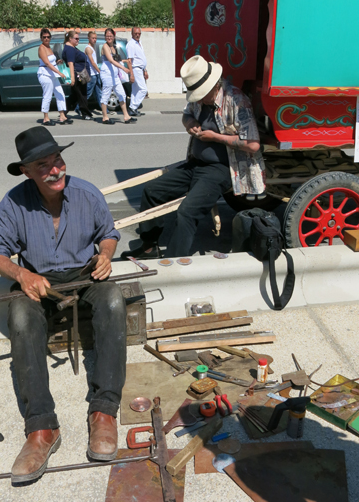
Francois, a French basket maker, is also next to me with his roulotte and when l try to buy a basket off him, he gives it to me, which is really kind . There is an English lady in her 70s and she comes down every year in an ancient camper van, she is very kind too. I get busy making copper candle holders and l have some already made and a basket of pegs to sell. People enjoy watching me working and everything sells. I'm really pleased and selling things is also a chance to practise speaking French.
Tinkering. Photo by Belle Benfield
It's a very relaxed atmosphere and people are here to enjoy themselves.
Flamenco dancers
Flamenco. Photo by Belle Benfield
Hungarian music
It's lovely hearing Gypsy music from Spain, Hungary and Romania and jazz Manouche. In the mornings l get up early and go to a cafe and treat myself to a grande creme. During the days it's very busy and it's exhausting talking to hundreds of people and having large cameras pointed intrusively at me, but it's an occupational hazard and l make the best of it. After long hot days in the sun, tinsmithing, it's nice to have something to eat in a cafe and then wander around listening to the music. Long after the sightseers have gone home some of the musicians continue to play for their own pleasure and the music takes on a new better quality.
Flamingoes, photo by Belle Benfield
After a week here l'm exhausted but content, l've ridden my horse in the Mediteranean, nine months ago l rode him in the sea in Cumbria. Now it's good to be on my way again.
Leaving Les Saintes Maries

Wednesday, 4 June 2014

Post 35. La Camargue


10th May. I got to  a lovely town called Sommieres, l stopped by the river near the arena or bullring and watched the young men learning how to be Razeteurs. The bull doesn't get hurt. The young men have to run pretty fast and try and pluck a ribbon from between the bulls horns; before the bull gets to them they have to jump out of the ring at the last moment, the bull is very athletic and good at jumping too.
Poppies near St. Laurent-d'Aigouze en Camargue
It's pleasantly hot, dry and dusty here, there are berries on some of the Mulberry trees, they taste a bit like blackberries. The nuts are ripening on the almond trees. I watched two ladies fishing and catching mullet near St. Laurent d'Aigouze, they had a stick fire and cooked them straight-away. Later they gave me two that they'd just caught and l cooked them, delicious.
Cooking mullet for dinner, in Camargue
I've travelled 800 miles [1,300 km],since l arrived in Calais, l'm elated to reach the Mediterranean. It's been quite a journey. It's taken 14 weeks, but three of those weeks l didn't travel and l had the odd day off too.
Stop'd at Quissac for a coffee
If you drove here in a car you wouldn't experience much at all. You wouldn't smell the Jasmine as you went through Aigues-Mortes, you'd have trouble parking, you'd be on big boring roads, you'd have to fill up with petrol......
You wouldn't stop for the night down an old track and hear the birds singing, flamingoes flying over in the sunset, you wouldn't hear a thousand frogs croaking, you wouldn't sit round a stick fire cooking tender steaks of the taureau, [the bull], you wouldn't shake hands with the horseman who was proud of the huge grey mules he'd purchased from Spain...... if you worked out the time you spent earning the money to buy and run your car, the time you spent sitting in your car travelling to and from work, you'd be surprised to find you were also going about the same speed as my horse, but with more inconvenience and little real pleasure; if you factored in the noise pollution and general degradation to the environment, you might find that you were going backwards.
On one side of the track are tough Camargue ponies, suited to this harsh but beautiful landscape, they are lean and look well, [you don't see fat ponies here], on the other side of the track are the black bulls of the Camargue, with their long sharp horns. A grass snake slivers across the track.
13th May. The Rhone Delta. I cross a river on a ferry, l like the idea, 'the ferryman takes me to the other side.' Have you ever been to the other side?
The ferry goes every half an hour, l have quarter of an hour to wait so l have a  drink in the cafe,  the horse waits patiently in the road, he's not tied up, he just stands there nicely, a car pulls up behind him and forms a queue. I finish my coffee and the ferry arrives.
The horse walks up the metal ramp onto the ferry, l think he quite likes the sound of his feet on the metal.The engines of the ferry are really noisy,  the horse stands quietly. On the other side of the river the metal ramp slams and grinds noisily onto the tarmac and we continue on our way.
Horse is not too bothered
The horse had never been on a ferry before like this. It's worth remembering that the instincts of a horse are never far from the surface; in times of perceived danger their instinct is to run as fast as they can. Not a great idea on a ferry whilst yoked up to a wagon. Just in case there was a problem l had a towel ready to put over his head, so that he wouldn't be able to see. It's hard to bolt when you can't see and what you can't see you don't worry about. Having success with horses is all about good preparation and training, before you take them to a show or on the road. Harvey Smith the show jumper said, 'you win your rosettes at home, you just collect them at the showground.'

The Rhone Delta
There are Camargue ponies everywhere, along the sides of the road are 'Promenades a Cheval,'  a couple of dozen horses will be tied up next to each other, all saddled up, patiently waiting to be ridden. An English 'horsey' person might describe the scene as, 'bored horses stand waiting to be ridden,' but they've got it the wrong way round. If you want to see bored ponies, go to an English riding establishment, watch the bored horses pawing the ground, fidgeting and pulling back on their lead ropes because they've never been taught how to be tied up and stand quietly. These horses know the value of standing quietly, conserving their energy. I doubt if any of these horses ever get laminitus. They're lean and fit. Not all the horses are Camargue ponies, some of the larger ones are Spanish.
For some days a strong wind blows from the north, maybe it's the Mistral, l don't know, it doesn't drive me any madder, despite its reputation. It does keep the midges and mosquitos away.
17th May. Went to St.Gilles, set off at 7am and got there at 11am, 20 miles [33km], went past lots of rice paddies, needed some shopping, bought a plastic tool in the pharmacie for removing ticks. It works well. Chemists in rural France sell veterinary supplies too.
I'm back in the Garrigue, l see date palms, huge cacti flowering. The wind drops, the temperature rises to 32oc. l stop by a canal, l spend the afternoon reading on the bed, well dozing really, it's cooling down a bit by 8pm, l make some dinner, then play my pipes, at 9pm the midges come out for their dinner, that's me and the horse. I retire to the wagon, the midges are French and are too polite to come in the wagon, Scottish ones do and are much fiercer. The mosquitos don't bother me, they prefer the blood of ladies and children, the horse gets lots on him but he doesn't seem bothered. In the morning l get up early and go back into St.Gilles, l have a look around and find a nice piece of grass in the large car park. There's shade for the horse and the grass is still green, so the horse is happy. There's a tap nearby. I buy a piece of pizza and a small quiche Lorraine and that's me organised for the day. I lie on the bed reading and sipping water laced with lemon juice, the water tastes slightly brackish and the lemon disguises it. Apparently St. Jacques de Compestela also came here, but this isn't really a touristy place. I like it, it's slightly run down and no one bothers you.
After a couple of days l go back down to the Camargue and go to the Gypsy pilgrimage at Les Saintes Maries de la Mer

Saturday, 17 May 2014

Post 34 The Mediterranean.‏

22nd April. I'm in a wild mediterranean landscape between the hills of the Cevennes and the Camargue. Fig trees, grape vines, olive trees, scrubby Holm oaks, Acacia and Thyme thrive here. I stopped at St. Hippolyte du Fort and fixed a shoe back on the horse, they've done 300 miles and the nails are starting to  break. I'm stopped on some grass near a supermarket and a busy road, it's ages since l've stopped somewhere noisy. The ground is hard and it's difficult to bang the tether pin in. The people are friendly and stop and chat to me. In the morning l stroll over to the supermarket and get a few bits, l don't need much. I'm out of practise at shopping.
Noisy stop, handy for supermarket
I carry on to Pompignan. On the way a young Frenchwoman stops to chat, invites me to lunch and organises a field for me to stop in, really kind. She cooks a nice Canelloni for lunch. After lunch I'm tired and have a siesta and don't wake up until 2am! Heavy rain wakes me and lasts for an hour, afterwards the scent of the flowers is beautiful. The sound of crickets and frogs croaking is incredibly loud. This is another somnambulant village but it does have a cafe and a bakery.While l'm at Pompignan, l hear of some people near Lasalle, who have two mules, but need help to learn how to use them, so l go there.
Nr Pompignan, 22 April.jpg
It's a smallholding and about ten enthusiastic young people in their twenties are living there and trying to learn how to live off the land, most of them, l think come from cities. It's really nice to have their company and help them with the mules. One mule has an injured leg, so we leave him to recover. The other mule is pushy and ill-mannered at first, but soon learns to behave himself. We make good progress and the best mule is soon learning how to pull things around. They are lucky to have found such a good mule.
The hills here are full of sweet chestnut. In the autumn, harvesting the chestnuts is an important part of the year. Pedro the mule will be able pull large quantities of them back down the hill to the farmhouse. The chestnuts are sold by the kilo to a cooperative. The mule will also be able to bring back large quantities of firewood. Most of the houses in rural France appear to be heated by firewood, in the colder parts the carefully stacked firewood is impressive. A lot of people in France work as wood cutters.
Pedro was ill-mannered, but he's getting nice now
8th May. I've been stopped at the smallholding for two weeks and been showing some of the people here how to train the mule each day. The mule has really improved and can now be used for a variety of jobs. [It's not hard to train an equine to do simple jobs around the place. Ponies that have been 'outgrown' can easily learn to pull a cart or drag back firewood].

Xavier, Pedro and Sara and Leon
Yesterday we used the mule to 'harrow' a piece of ground. That was a real success. The fields are tiny, terraces carved out of the steep hillside. We have got no suitable bridle or bit for the mule and because of the small fields and inexperience of his handlers, it is easier to have one person leading the mule and another one steering the implement for cultivating the ground. Although this is a bit inefficient, it's still a lot quicker than digging the ground by hand and the two people have to work as a team and  help each other. It's more about quality of life here than being very efficient, but as they learn more they will improve.

Panniers are good to carry things
In southern France much of the land was cultivated using one or two mules and there are quite a lot of suitable implements lying around that are still serviceable. In Britain the available horsedrawn equipment is generally only suitable for heavy horses. It is possible in France to buy new equipment too, which is handy and some vineyards and farms still use mules.

Leah and Xavier using a harrow


Yesterday we prepared some ground to sow some maize, it was hard work for one mule, so we finished the job with my horse. As well as maize they are growing chick peas, vegetables, fruit, some barley for beer and some oats. The farm has a good spring and a good stream, the ground appears to be very fertile and l don't think the young people will have too much trouble managing. They are resourceful. They killed two goats this morning and a ram to eat.


We have improvised some of the harness, using car safety belting. That works well for the traces. I'm really pleased how the young people are now getting on and using the best mule to do various jobs. They are pleased too, so tomorrow l shall head south down to La Camargue. It's been a real pleasure to stay at the farm and l feel like the horse and l have had a good rest.

Post 33 Tethering Horses.‏

Unless l'm offered a field with a good fence for the night, l need some way to secure my horse, so that he doesn't wander into the road, so l have to tether it. In the old days when armies had cavalry, when they were on a campaign, all the horses were tethered or picketed, even expensive chargers belonging to generals.
Some people might think it was a bad idea or cruel to tether a horse. Done well it is very good for a horse, it makes them much safer and calmer, prevents them getting injured.
l get him used to the feel of a rope around his legs, then a piece of plastic hose pipe and then a chain. This is a great thing to do, even if you never tether your horse, because when your horse feels something strange around its legs it is less likely to panic. If your horse is in harness it will not worry if it gets its leg over a trace, or if it gets its leg caught in some sheep fencing, it will wait for you to come and help it, if it isn't used to things round its legs, it may well break its leg as it frantically tries to release itself. A horse that is good on a tether learns to stand still and wait, it's also better at being shod.
Many young horses are put straight on a tether, without any preparation and after a struggle they learn all this themselves, without you doing anything, but there is a small risk. Until they are good on a tether, l tether them on level ground and not near anything that will injure them. I tie them up first in a yard for a few hours, until they are hungry, then tether them on some nice sweet grass, they soon get the hang of it and look forward to it. I keep an eye them.
After a while horses love their tether, they learn to use it to rub and massage themselves.
Tether pin and tether chain
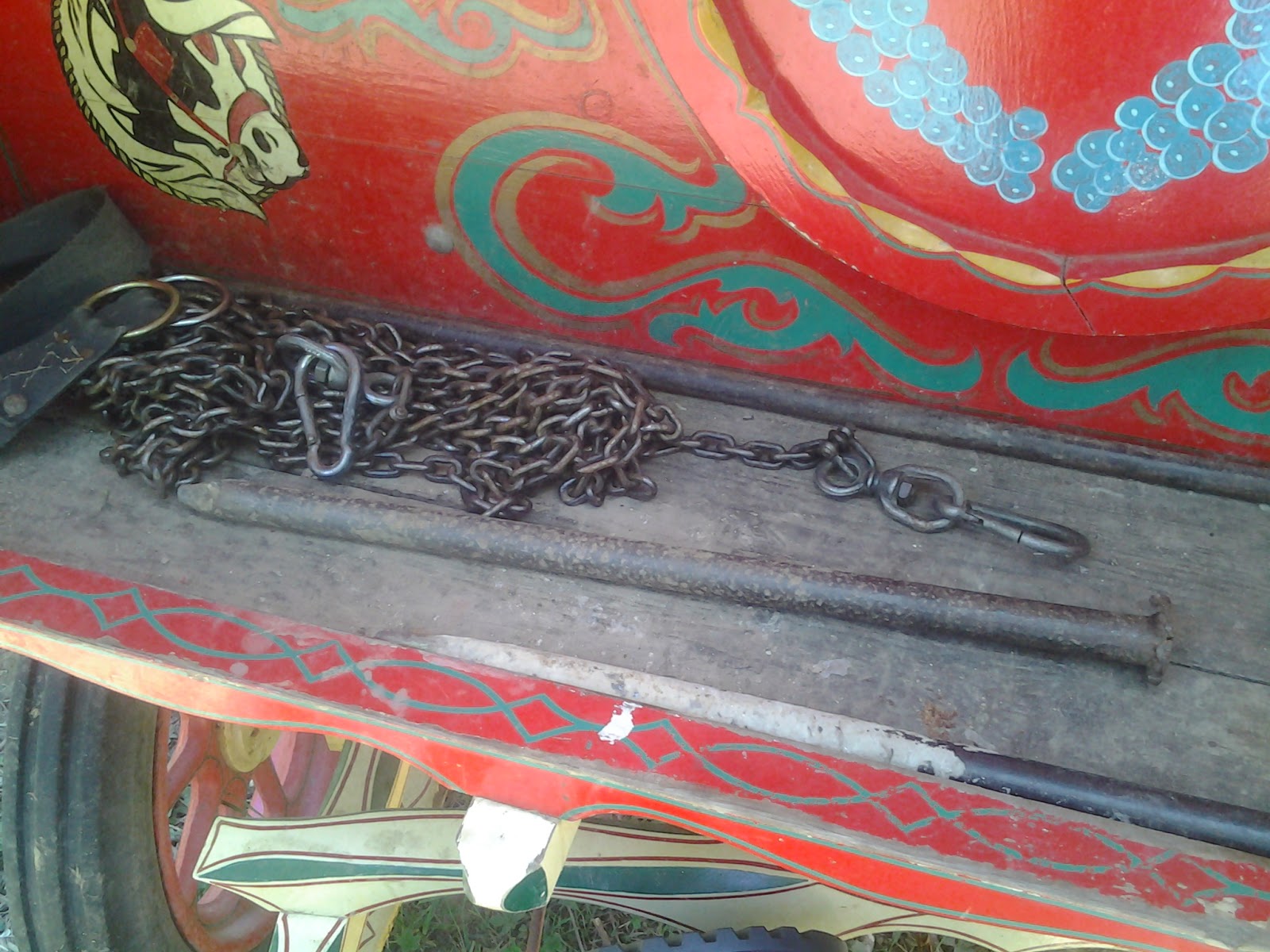
To tether them l have a length of chain about 25 feet [8m] long, it has three swivels in it, otherwise the chain will go solid when the horse rolls, and that's one way they can injure themselves. The peg, or tether pin, is 25mm in diameter,[1"] and about 600mm [2'] long, with a point on one end and a small head on the other. I may need a longer one on soft ground, on sandy ground l have to fix the chain to a shrub or tree.
Swivel and clip on tether chain
To the end of the chain you need a neck strap, [l use a length of car safety belt], to which l fix a clip, or l can fix the chain to a head collar.
Neck strap made from car safety belt
When l stop on the sides of roads there often isn't enough grass for the whole length of the chain, so l may have to move the tether several times, it depends on the quality of the grass. The grass near the hedge will normally be coarse and long and the horse will prefer the shorter sweeter grass near the road. I try to tether the horse near the back of the wagon at night time so that l can see it out of the window and make sure it's ok. It's lovely hearing the horse crunching grass at night time. The horse is glad to be near the wagon too, it feels safer. I'm careful not to tether the horse so close to the wagon that it can rub its bottom on it. He'll wait until 3 am to do it and wake me up.
Horse tethered on Blackheath, London
Sometimes at horse fairs, children like to go round at night letting horses off their tethers. The  younger horses will run around but the older more experienced horses tend to just stay near their own wagon. I remember one morning at Stow horse fair, in the Cotswolds, waking up and my old mare was lose, but she was just standing between the shafts waiting for me to get up, and that was lovely.
Belle rolling by Soulby Bridge, whilst tethered
Other advantages of tethering a horse is that it learns to cross its legs over to move sideways and sidepass, a very good thing for a driving or riding horse. A horse that has been tethered alongside a road soon gets used to lorries and cars. A horse that ties up well and tethers well is more valuable. It's also possible to use pieces of grass that are not fenced.
Horses tethered at Appleby

Friday, 9 May 2014

Post 32. Les Gorges du Tarn et Les Cevennes

14th of April. 12 miles, [19km]. Hot and sunny again. I went through the village of le Messegros, bought some food and sat outside a cafe and had a coffee. I chatted to the secretary of le Marie and she let me use le wifi to check my emails. It's really nice to get my emails and sometimes  people make kind comments about my blog, which l appreciate. The villages in this part are very old and interesting. A Flemish couple invited me to lunch, I enjoy having nice food with people and while we're talking often learn useful information about the locality and the route I'm taking.

It's a 1,450 feet drop down to the river
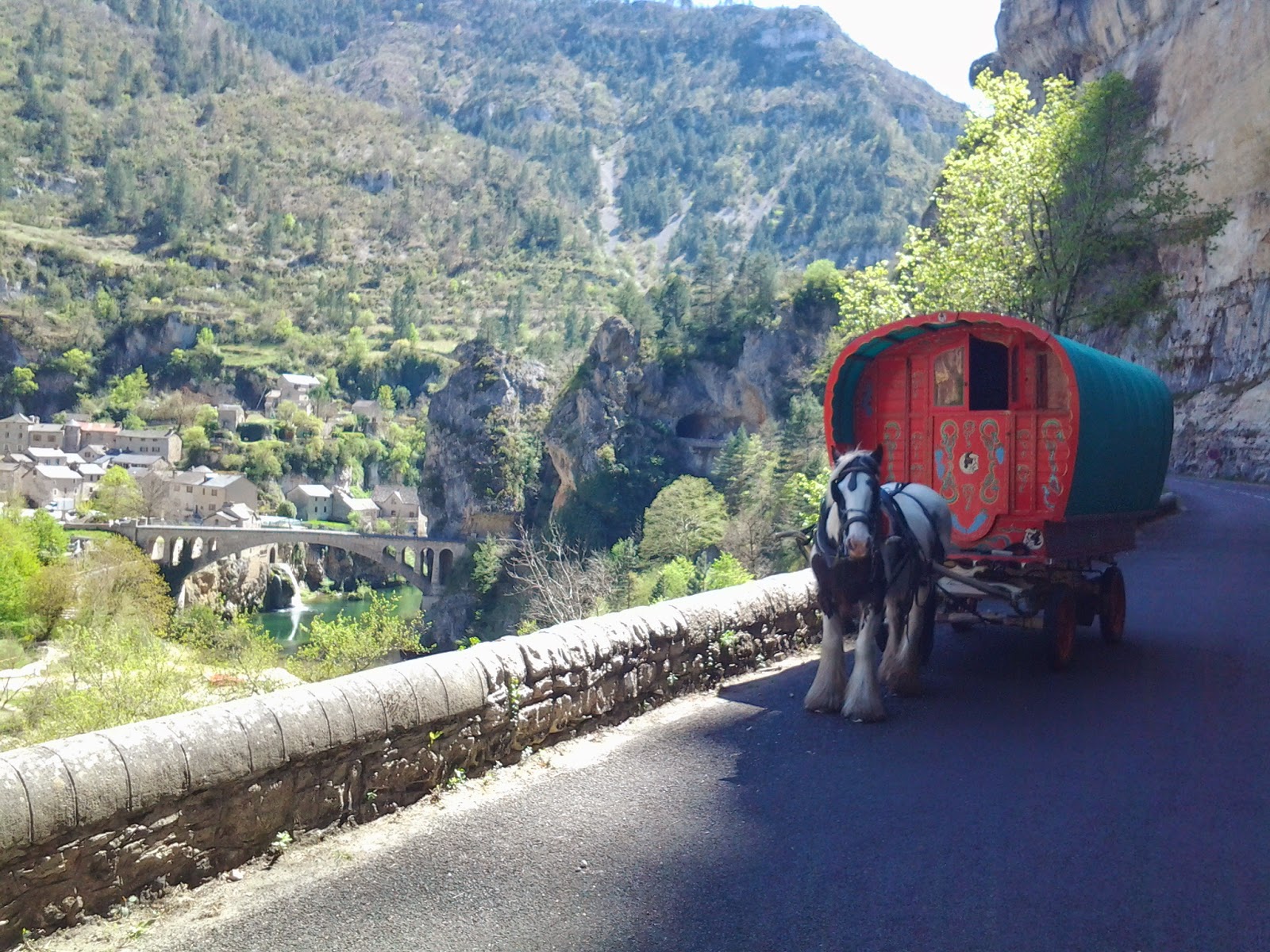
I carried on and stopped at Le Point Sublime, which has really great views of the gorge and river Tarn, 1,450 feet below [442m]. In the morning it was cold and when the sun came over the hill l stood warming myself and watched some birds of prey rising on the thermals and no doubt warming themselves too. I'm 700 miles south of Calais.
15th April. I descended the gorge to the village of La Malene. The road was steep and winding.

Roads are quite winding
I had to wind the brake on hard.

Gorges du Tarn. 15th April
The horse can hold the wagon back a bit, using the britchin of his harness. If you didn't have a brake as well, the weight of the loaded wagon, 850kg, would push the horse too much and he'd lose his footing and you might have an accident.
Down in the gorge it's really hot and sunny.

Elm brakelock, almost worn out
The road that winds its way along the gorge is narrow, there are huge, intimidating overhangs of rock, that almost touch the wagon roof, narrow low tunnels, that thankfully are not very long, just high enough to get through, l'm glad l have a good horse, a spooky, erratic horse would be exhausting to drive along here, there is little margin for error. After 15 miles the horse and l are getting tired, l'm really glad when l pass a campsite and they say it's fine for me to stay. It's 13 Euros, well that's fine, it's a lovely place, l'll have a good shower and sit on the terrace of the cafe and use le wifi. The people are very kind and l'm glad to be stopped. In all the years l've travelled l don't think l've ever stopped in a campsite before and l don't think many would let me. It's the first time l've paid to stop somewhere. I had a lovely nights rest and in the morning, the lady, Emilie, who runs the place took photos and gave me a bottle of the local wine.

Tunnels through gorge, just higher than wagon
16th April. I carried on up the gorge another 11 miles, [17km]. The gorge is so dramatic and imposing it tires me. Again there was nowhere to stop so I asked at the municipal camping of Ispagnac. They were also very friendly and welcoming, 'pas de problem.' They charged me 9 euros, which is fine, l'm glad to stop, the grass is good and l don't have to look for water and l can go up to the village on my own without the horse. I'm the only person at the campsite! Usually the weather isn't so good at this time of year. This year is unusually warm. I've been very lucky to be able to stop at these campsites and it's only possible because there is no one about.
Tarateeno still has remnants of his winter coat.l pulled some long  soft and downy bits off his belly, l measured them, 8 inches long [200mm]. That's how he keeps warm in winter.
17th April. Went through Florac, a small town, climbed 500 metres, [1,640 feet] to an altitude of 1020 metres, [3,346 feet]. [It's almost as high as Ben Nevis in Scotland, the highest mountain in Britain]. It was a long old pull, 13 miles, [22km] in hot sunshine, the horse was tired and dripping with sweat from the exertion, but at the top of the hill we pulled onto a big piece of rough ground and after 10 minutes his flanks had stopped heaving and his breathing was back to normal, he's fit. That's the toughest hill we've had so far. There is a great sense of achievement getting up a hill like that. About a mile from the top l got 6 gallons, 30 litres of water from a spring. When we got to the top l unyoked the horse and put a little water in the bucket, just to wet his lips and rinse his mouth, then when he'd cooled down l gave him a whole bucket.
I'm on a ridge, called the Corniche des Cevennes, it's dry like a desert, scrubby pine trees and rough stony grazing, inhabited mainly by lizards. This bit is a desolate lonely place; with a bit of luck a beautiful shepherdess will turn up with some goats and l'll share some wine and food with her and see how it goes on from there, it gets cold at night up here.
I did read a book once by the writer Robert Louis Stephenson; he described coming up here with a donkey, an anesse, called Modestine, he had trouble to get her to go. Happily my horse walked up here quite willingly without any encouragement with a stick or goad. In the old days all sorts of methods were resorted to, to get up a hill, if your horse laid down in the shafts and refused to go on, you might try lighting a fire under it, we still have the expression today,  'light a fire under it,' but people have forgotten its origins.
I woke up in the morning refreshed, l looked out the window and the horse called a cheery greeting, that's good enough for me. It's quite cold in the mornings, l lit the stove and made tea, scrambled eggs and toast.
Despite his exertions yesterday, the horse looks great and l'm really pleased with him.
After breakfast, l went back to bed and read a book for the whole day, l thought we'd have the day off, the horse didn't mind. I moved his tether a couple of times, gave him some bread and he's drunk most of the water, so l'll head off in the morning. I wonder what l'll find down the road?
I set off at 8am, it's cold and my hands are a little numb, the horse walks along briskly for a while to warm up. In the night a chilly wind got up, reminding me l was 3,400 feet up and the weather can change suddenly.This is really lovely wild country, huge ranges of hills as far as the eye can see. l get to the village of le Pompidou, the villages have a wild remote feel about them too.  l water the horse at the spring. These villages only exist because of the spring, there are no streams in this part . At 3,400 feet the weather can be bad even in April, you wouldn't want to be in a tent. The farmers don't bring their livestock up this high until later in the year. I've been very lucky with the weather, it's been a gamble.
People sometimes confuse this type of travelling with a camping holiday and they think it looks nice and romantic and an easy going free sort of life. Well it can be quite easy if you're used to it, if you know what you're doing, but there can be very tough times too. If you're not used to this way of life you might find it pretty tough, challenging, uncomfortable and at times scary. Constantly moving, not knowing where you were going to stop. There would be times when you felt unsafe and insecure. You have to learn to think differently, sieze chances, be resilient, have the impudence to dare and to leave most of what you learned before behind. If you can adapt to it the rewards are great. It's a life of extremes.
I stopped the night in a big layby in a pine wood, there was enough good grass for one horse. A nice French woman came by and chatted to me and said she had just built herself a wagon and was hoping to train her horse to pull it, it was good talking to her, who knows we may meet on the road one day? I asked her if she could take my water container in her car and fill it at a spring a mile away. This she kindly did, l thought it would be good practise for her too.
My container for the horse holds 25 litres, that's 25 kilos, quite heavy to lift with one arm, and very heavy to carry more than a few yards. If you're 4 stone overweight, you're carrying that all the time, you may feel tired.
Some French people stopped and chatted to me.They asked me where l'd stop the night and were surprised that l was stopping there, 'camping sauvage' is not something most of them would do. If you have a van or camper, stop in the smaller towns, where they have parking for you and a tap, it's safer and more acceptable, l do it myself sometimes if there's some grass for the horse. I like waking in a village and getting a croissant for breakfast.
A bit later some Spanish people came and chatted, they were very kind and friendly, if the people of Spain are like them l would like it there.
Ticks are a problem in the countryside, lt's important to keep your skin covered when walking through long vegetation. Sometimes the horse gets lots of them, especially round his muzzle. I loathe the way they bury their heads into your skin and spend days drinking your blood.
I go past a memorial to resistance fighters who died in the war, interestingly the first three dozen on the list are Germans, anti-fascists,  as well as French names, there are also Spanish and Russians.
St Chely-du-Tarn
I'm often asked how much does a horse drink? This depends on several factors. How wet is the grass, was the dew heavy, is it salty grass beside the sea, how hot the sun is, is there a dry wind, how fit your horse is, the size of your horse, how hard is it working.....? Some horses seem to need more than others. A thirsty horse can drink 3 to 5 gallons, [11-19 litres] straight-away.
A litre of water weighs 1 kilo, it's heavy, you don't want to carry it more than you have to. I prefer stopping places that have water, but if l know they haven't, l get some on the way at a nearby house or farm. Very few people will refuse a horse water, although l have had it happen. When it's raining, horses get enough moisture from the wet grass. One summer it didn't stop raining, l didn't mind not having to find water for the horse, but it was hard to find dry firewood. As much as possible l try to water the horse on the way, it's easier.
How much water does a person need? I generally make sure l've at least one gallon [5 litres], that's enough for washing hands, drinking, cooking some rice and washing up, l can manage on less if l have to, l prefer to have two gallons, then l have enough to have a strip wash and a shave. I'm careful about the water l drink, but for washing most streams in hilly country will do, you usually get a pretty good idea by looking. See what's growing in the stream, is there rubbish in it, is there a farm or village above it, walk up the stream a bit, see if there's a dead sheep in it. If the horse doesn't drink it , it's bad.
Castelbouc, Gorges du Tarn
Sunday, 20th April. I came over the Col St.Pierre and suddenly l'm in a different country, the hill is covered in Holm oaks and l know l'm not far from the Mediteranean. I descend a steep winding hill to St. Jean-du-Gard, l stop and buy some bread then carry on to a bridge over the river Salendrinque, unusually there is access and rough grass to the river, usually there are signs saying keep out, but nothing here, so l pull over and make myself at home. I saw up some dead branches of walnut and light my stove, it's not very cold but it's started to rain. It rains all afternoon, l'm glad, it'll be good for the grass.l get a couple of visitors, nice ones, they chat about horses and as they speak slower here l can understand better, even though they pronouce some words very differently from further north. The people down here seem more forgiving about the way l speak French.
I'm only 600 feet [180 metres] above sea level now, the grass here is 2 months ahead of what it would be in England. There are roses out in gardens, the leaves are out on the walnut, sweet chestnut and acacia, the thyme is flowering and l've seen bamboo with stems as thick as your wrist.

In the last five weeks l've crossed  a range of huge hills, 300 miles of them, and l feel great and elated to be down here. Now l need to find somewhere else to go.